
Introduction
Arthritis is an umbrella term that describes more than 100 conditions affecting the joints, ranging from mild discomfort to chronic disability. It is one of the leading causes of joint-related health issues worldwide, with millions of people living with the condition. In Singapore, arthritis is also common among both younger and older adults, making it a frequent reason for seeking medical advice. Among the many types of arthritis, osteoarthritis vs rheumatoid arthritis are the two most common forms that often draw attention in both medical discussions and everyday conversations.
While both conditions share overlapping symptoms such as joint pain, stiffness, and reduced mobility, the underlying causes are quite different. Osteoarthritis usually develops gradually as the protective cartilage wears down, whereas rheumatoid arthritis is an autoimmune condition in which the body mistakenly attacks its own joints. These differences influence how each condition progresses over time and the type of care that is recommended.
Recognising the two conditions helps in understanding how they shape daily activities and the kinds of treatment approaches that may be needed. For example, osteoarthritis is often linked to long-term mechanical stress on the joints, whereas rheumatoid arthritis involves immune system regulation and broader health monitoring. Recognising these distinctions can help individuals take earlier action and approach consultations with clearer questions.
This article highlights the key differences between osteoarthritis vs rheumatoid arthritis, offering practical insights for individuals experiencing persistent joint symptoms. By understanding how these conditions differ, readers can better recognise early warning signs and feel prepared when discussing their concerns with a bone specialist in Singapore.
Key Takeaways
- Different underlying causes – One form arises mainly from joint wear over time, while the other stems from immune system activity.
- Distinct symptom patterns – Stiffness, pain, and swelling are common to both, but one often starts in larger weight-bearing joints, while the other tends to affect smaller joints and shows symmetry.
- Progression and impact – One develops gradually and is localised, while the other may progress more rapidly and sometimes affect organs beyond the joints.
- Diagnosis and management – Identifying the condition involves a combination of physical examination, imaging, and, in some cases, blood tests, with treatment aimed at long-term symptom control and maintaining joint function.
Part 2: How These Two Conditions Develop and Progress
2.1 What Triggers Osteoarthritis and Rheumatoid Arthritis
Osteoarthritis develops gradually from the natural wear and tear of joints. Over time, the protective cartilage that cushions the bones breaks down, causing discomfort and limiting mobility. This process is often described as mechanical because it involves physical stress placed on the joint surfaces. Factors that increase the likelihood of osteoarthritis include ageing, repetitive joint use, previous injuries, excess body weight, and occupations or sports that involve heavy joint loading. A family history of the condition may also increase susceptibility, making it important to distinguish osteoarthritis vs rheumatoid arthritis in relation to risk factors.
Rheumatoid arthritis, in contrast, is not caused by mechanical wear but by the body’s immune system turning against itself, making it a form of autoimmune arthritis. In this condition, the immune system mistakenly attacks the lining of the joints, triggering inflammation that damages cartilage and bone over time. Unlike osteoarthritis, which is primarily localised, rheumatoid arthritis involves an immune response that affects the body more broadly. Risk factors include a genetic predisposition, being female, certain hormonal influences, and environmental exposures such as smoking or past infections. These differences clearly highlight the distinct underlying causes of osteoarthritis vs rheumatoid arthritis.
2.2 Patterns of Joint Involvement and Symptoms
The way osteoarthritis vs rheumatoid arthritis present in the body often helps doctors tell them apart. Osteoarthritis is more likely to affect weight-bearing joints such as the knees, hips, and spine, although it can also occur in the hands. Symptoms often start in a single joint and progress gradually over many years or even decades. People may first notice stiffness after sitting for long periods, pain when climbing stairs, or discomfort after walking long distances. In the hands, everyday tasks such as turning a key or opening a jar may become more difficult as the condition progresses. Common signs include pain that worsens with use, stiffness after periods of rest, and a grating or clicking sensation when the joint moves.
Rheumatoid arthritis, however, tends to show a different pattern. It often begins in smaller joints such as the fingers, wrists, or toes and usually affects both sides of the body at the same time.
Unlike osteoarthritis, which develops gradually, rheumatoid arthritis can develop more aggressively over months or a few years. People may experience difficulty with everyday routines such as fastening buttons, writing, or holding utensils. Morning stiffness that lasts longer than an hour is a typical feature, while fatigue, low-grade fevers, and a general feeling of being unwell may also occur. Understanding these patterns helps distinguish osteoarthritis vs rheumatoid arthritis in daily life. This systemic involvement is one of the features that separates osteoarthritis vs rheumatoid arthritis when comparing their overall impact.
2.3 Differences in Disease Progression and Joint Damage
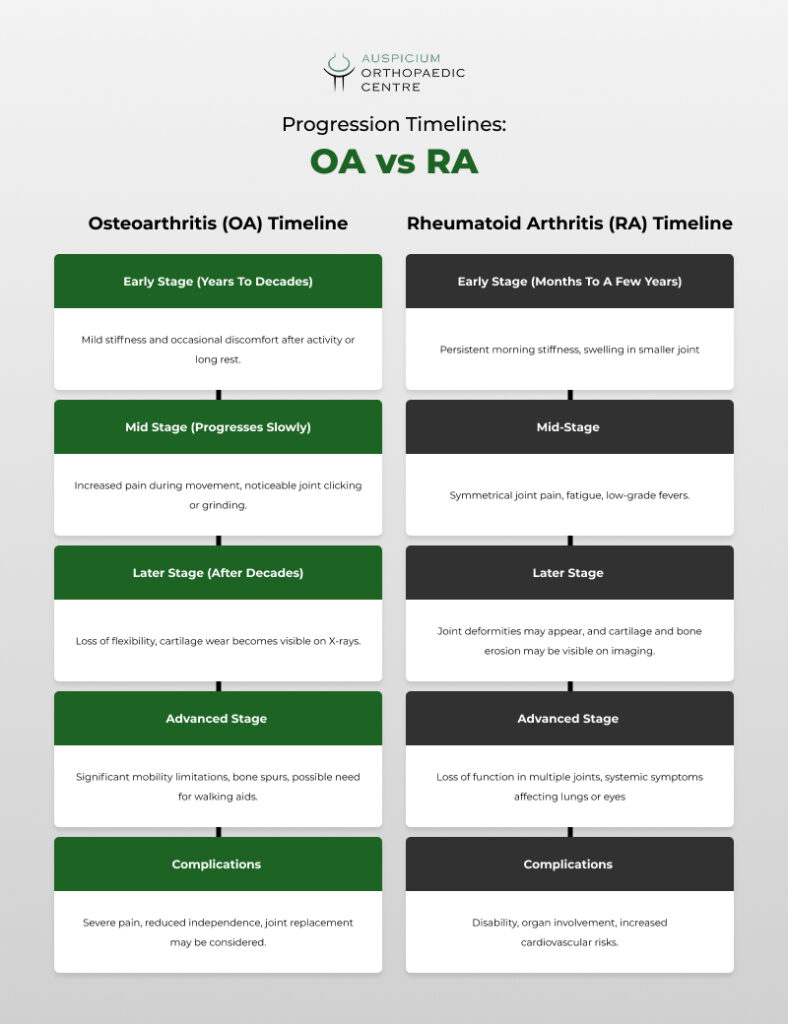
When it comes to progression, osteoarthritis vs rheumatoid arthritis follow very different paths. In osteoarthritis, cartilage damage develops gradually and is usually limited to the affected joint. This gradual process of cartilage degeneration means that as the cartilage thins, bones may begin to rub directly against each other, leading to friction and discomfort. Over time, bone spurs can form, and mobility may gradually decline. If osteoarthritis is not managed, it can lead to reduced independence in daily activities, difficulty walking longer distances, and eventually the need for assistive devices or surgical intervention.
Rheumatoid arthritis progresses more quickly if it is not addressed in the early stages. Ongoing joint inflammation can damage cartilage, erode bone, and lead to visible deformities. Rheumatoid arthritis can affect multiple systems, whereas osteoarthritis is usually limited to specific joints. In some cases, it may contribute to complications in the lungs, heart, or eyes, adding further health concerns for patients. These systemic effects highlight one of the major differences between osteoarthritis vs rheumatoid arthritis, making careful monitoring an important part of long-term care.
Living with either condition can also have a psychological impact. Chronic joint pain and reduced mobility often interfere with work, exercise, and social activities. Over time, this may lead to frustration, feelings of isolation, or even anxiety and low mood. Recognising how osteoarthritis vs rheumatoid arthritis influences both physical and emotional wellbeing can encourage individuals to seek support from healthcare professionals, family, or community networks.
Part 3: Diagnosis, Management, and Living With These Conditions

3.1 How Doctors Diagnose Osteoarthritis and Rheumatoid Arthritis
When a person presents with ongoing joint pain, stiffness, or reduced mobility, doctors use a combination of approaches to determine whether the cause is osteoarthritis vs rheumatoid arthritis.
For osteoarthritis, diagnosis usually begins with a detailed patient history and a physical examination of the affected joints. Doctors typically assess joints for reduced range of motion, swelling, or tenderness. Imaging tests such as X-rays are commonly used to identify cartilage thinning, changes in bone structure, or the presence of bone spurs. In most cases, blood tests are not required for osteoarthritis, unless they are needed to check for other conditions that may cause similar joint symptoms. Conditions such as gout, lupus, or fibromyalgia can sometimes resemble osteoarthritis in their early stages, so additional tests may be carried out to exclude these.
For rheumatoid arthritis, diagnosis can be more detailed. As it involves the immune system, blood tests are often a key part of the evaluation, measuring markers such as erythrocyte sedimentation rate (ESR) or C-reactive protein (CRP). Doctors may also look for antibodies such as rheumatoid factor (RF) or anti-cyclic citrullinated peptide (anti-CCP), which are frequently associated with the disease. Imaging methods such as ultrasound or MRI can reveal early changes and erosion that may not yet be visible on standard X-rays, which helps doctors differentiate osteoarthritis vs rheumatoid arthritis during assessment.
Identifying rheumatoid arthritis in its early stages can be difficult. Some patients initially present with joint pain that resembles osteoarthritis, and symptoms can overlap, especially when the disease first appears in middle age. In these cases, careful monitoring and repeat testing may be needed before a clear diagnosis is established, making arthritis diagnosis and treatment an ongoing process. Excluding other conditions and observing symptom patterns is central to distinguishing osteoarthritis vs rheumatoid arthritis in clinical practice.
3.2 Treatment Approaches and Day-to-Day Management

The treatment of osteoarthritis vs rheumatoid arthritis varies, as the two conditions arise from different underlying causes.
For osteoarthritis, the primary aim is to reduce joint strain, relieve discomfort, and maintain or improve mobility. This is achievable through:
- Physiotherapy and targeted exercises may help strengthen the muscles that support affected joints. Examples include quadriceps exercises for the knees or hand exercises to maintain grip.
- Joint-friendly activities such as swimming, cycling, or yoga can support flexibility without adding excessive strain on the joints.
- Pain management may include oral medications, topical creams, or corticosteroid injections during periods of increased discomfort.
- Lifestyle adjustments, particularly weight management, help to reduce pressure on weight-bearing joints such as the knees and hips.
- Joint protection techniques, such as pacing activities, using ergonomic tools at work, or adapting household routines to reduce repetitive strain.
- Braces and supports, which can stabilise affected joints and make everyday movements safer and less uncomfortable.
- In severe cases where mobility is significantly reduced, joint replacement surgery may be considered. Many patients seekknee arthritis treatment in Singapore when pain and stiffness affect daily movement, particularly in weight-bearing joints.
For rheumatoid arthritis, treatment is generally more intensive and aims to regulate immune activity, reduce inflammation, and limit joint damage. Options may include:
- Disease-modifying antirheumatic drugs (DMARDs) aim to slow progression.
- Biologic therapies or immunosuppressive medications that target specific parts of the immune response.
- Regular monitoring is important, as treatment plans may need adjustment depending on how the condition evolves.
- Supportive care, such as occupational therapy to help patients adapt their daily activities, mental health support to address the impact of chronic illness, and practical strategies for coping with fatigue.
With both conditions, non-medication approaches remain important. Diet can play a role, with emphasis on maintaining a healthy weight and, in some cases, reducing foods that may increase inflammation. Physiotherapy may include low-impact strengthening, stretching, and balance exercises that can be practised at home. Long-term management also requires consistent follow-ups to track disease activity, adjust treatments, and prevent complications. In some cases, individuals may first seek advice from a sports injury doctor in Singapore when symptoms appear during physical activity. These considerations become particularly important when comparing osteoarthritis vs rheumatoid arthritis in long-term care.
Physiotherapy goals and exercise routines may look different for osteoarthritis vs rheumatoid arthritis, since one is associated with mechanical wear while the other involves immune system activity.
Living with arthritis often benefits from a team approach involving doctors, physiotherapists, dietitians, and mental health professionals. With structured support, individuals can manage symptoms, preserve function, and continue participating in daily activities. Recognising how osteoarthritis vs rheumatoid arthritis affects everyday routines can also help patients make practical adjustments both at home and at work.
3.3 Questions You Might Have
1. Can someone have both osteoarthritis and rheumatoid arthritis?
Yes, an individual can develop both conditions. Osteoarthritis often appears later in life as joints undergo natural wear and tear, whereas rheumatoid arthritis can occur earlier due to autoimmune activity. Having one type of arthritis does not prevent the other from occurring, and in some cases, the two may overlap. A rheumatologist or knee specialist in Singapore can assess symptoms, order tests, and create a management plan that addresses both conditions if necessary.
2. Which type of arthritis is more severe?
The severity of osteoarthritis vs rheumatoid arthritis depends on how soon each condition is recognised and how consistently it is managed. Rheumatoid arthritis may be more aggressive because it involves ongoing inflammation that may damage joints and even affect other organs if untreated. Osteoarthritis progresses more gradually, but the resulting cartilage loss and bone changes can cause significant pain and mobility limitations. Both conditions can become highly disruptive if not managed appropriately, underscoring the importance of timely diagnosis and treatment.
3. Are there lifestyle factors that increase risk?
Yes, lifestyle choices can influence the likelihood of developing arthritis. For osteoarthritis, repetitive joint strain from work, high-impact sports, obesity, or previous injuries are key factors. Rheumatoid arthritis is more strongly influenced by genetics, but environmental factors such as smoking, poor sleep, and certain infections can also play a role in triggering immune system responses. Maintaining regular activity, managing weight, and avoiding smoking can help reduce overall risk.
4. Is joint replacement only for osteoarthritis?
Joint replacement surgery is most often associated with osteoarthritis because it directly addresses the mechanical wearing down of damaged joints. However, it may also be considered in rheumatoid arthritis if joint destruction becomes severe and non-surgical treatments no longer provide relief. The decision is usually made on a case-by-case basis, taking into account the patient’s age, overall health, level of pain, and daily mobility needs. In such situations, patients may explore options for orthopaedic surgery in Singapore, where surgery may be considered to support joint function and mobility.
Conclusion

When looking at osteoarthritis vs rheumatoid arthritis, it becomes clear that although both conditions affect the joints, their underlying causes, symptom patterns, and long-term progression are quite differ. Osteoarthritis is often associated with gradual cartilage wear and mechanical stress, whereas rheumatoid arthritis arises from immune system activity that can involve multiple joints and, in some cases, other organs.
Recognising these differences is important because it helps individuals notice early warning signs and seek care that matches their condition. Persistent joint pain, stiffness, or swelling should not be ignored. Keeping track of when symptoms occur, how long they last, and which joints are affected can provide useful information for a doctor. Early recognition of osteoarthritis vs rheumatoid arthritis not only helps manage immediate discomfort but also reduces the likelihood of further joint damage or complications in the future.
If you have ongoing joint discomfort, consult Auspicium Medical, an orthopaedic clinic in Singapore, for a clearer understanding of your joint health and tailored treatment options. Book a consultation today to manage discomfort and prevent further complications.